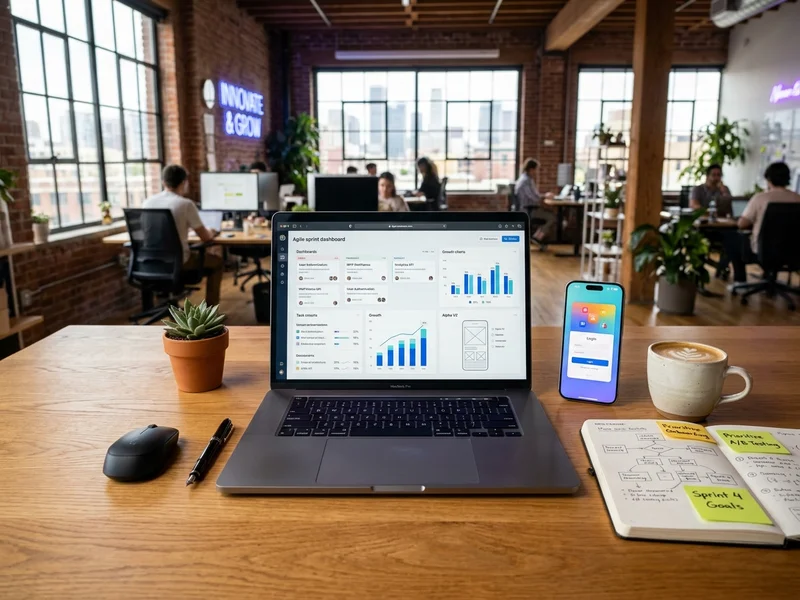
What a startup actually needs from a website and app
A startup does not need a heavy corporate site. It needs a clear page that explains the product in ten seconds, a way for people to sign up or get in touch, and tracking that shows what is working. Often it also needs a simple web app or mobile app where the real product lives. The trick is building these in the right order, with the smallest effort that still teaches you something real about your customers.
That is where we start every website development and app development project for founders. Before we talk about colours or code, we talk about who your first hundred users are and what they need to do on day one.
Planning a lean first version of your product
Start with an MVP, not the full product
A minimum viable product is the smallest version of your idea that real people can use and give feedback on. It is not a rough draft and it is not a demo. It should work, look trustworthy and solve one problem properly. Everything else can wait for version two, when you have data to guide you.
How we decide what goes into version one
- We write down every feature you have in mind, including the ones you are unsure about.
- We mark each one as must have, nice to have or later, based on what a first user needs to finish the main task.
- We map the shortest path from a visitor landing on your site to getting value from your product.
- We build only that path, test it with a few real users and then decide what to add.
Some founders worry that a small first release will look weak. In our experience a focused product that works beats a crowded one that crashes. Early customers and investors care far more about traction than about the length of your feature list.
Feature priority at a glance
| Priority | Meaning | Example |
|---|---|---|
| Must have | Needed to complete the main task | Sign-up, the core action, payment |
| Nice to have | Improves the experience | Reviews, referral codes |
| Later | Waits until real data guides you | Loyalty points, advanced reports |
Website, web app or mobile app: what to build first
Pick the format that matches how people will use your product.
| Format | A good first step when | Watch out for |
|---|---|---|
| Website or landing page | You are testing demand and collecting sign-ups | It does not deliver the product itself |
| Web app | Users log in to book, buy or manage something | Needs more planning than a website |
| Mobile app | You need notifications, camera, location or offline use | Higher cost, and store approvals take time |
Our website development and app development teams can start with the smallest option and grow it.
Design, technology and common startup mistakes
Design and branding that build trust early
With no track record, design builds trust quickly.
- Clean layouts that load fast on mobile
- A consistent look across your site, app and social pages
- A simple identity from our logo design and website designing teams
Technology choices that will not box you in
We choose the stack after scoping. These are the usual options for a first version.
No-code and template tools
When to choose no-code tools
- Testing an idea in days with almost no budget
Limits of no-code tools
- Hard to customise, and your data may be locked in
WordPress
When to choose WordPress
- Content-led products, blogs and simple shops
Limits of WordPress
- Complex logic needs custom plugins
Custom code
When to choose custom code
- User accounts, dashboards and workflows that must scale
Limits of custom code
- Higher upfront effort
Whatever we pick, we add secure login, backups, analytics and payments through payment gateway integration, on reliable web hosting.
Mistakes we help founders avoid
- Building for investors instead of users, and adding features that look good in a deck but nobody asked for
- Spending the whole budget on the first release and having nothing left for fixes and marketing
- Choosing a template or tool that cannot support the product once it gains users
- Skipping analytics, then guessing what users want
- Launching with no plan for how people will discover the product
Red flags in a startup development quote
- A fixed price with no list of screens or features
- No prototype before development begins
- Promises of thousands of users, which no developer controls
- Unclear ownership of code, domain and hosting
Launching and finding your first users
Getting your first users: SEO and early marketing
Building the product is half the job. Someone has to find it. We set up the basics of search engine optimization during the build: clean page titles, proper headings, fast load times, a sitemap and structured data. After launch you can add blog content, local listings, social campaigns and paid ads through our digital marketing team, and keep your messaging steady with our content writing service.
Startup launch checklist
- Domain (see domain registration), business email and HTTPS ready
- Analytics and conversion tracking installed
- Forms and payments tested on a phone
- Page titles, descriptions and a sitemap set
- Privacy policy and terms published
- Google Business Profile and social pages created
- A simple plan for your first 50 users
Working with us: timelines and location
Timelines, budget and how we work
A simple business or startup website usually takes one to two weeks. A custom web app or the first version of an MVP typically takes three to six weeks, depending on how many features are in scope and how quickly feedback comes back. We give you an itemised quote with no hidden charges, and we split the work into milestones so you can see progress and change direction early.
During the project you get plain-language updates instead of technical jargon. After launch you can reach us on WhatsApp and email for fixes and small updates, and we can plan version two when you are ready.
Founders in Delhi NCR, Jharkhand and Bihar
Founders from Deoghar, Ranchi, Patna and Delhi NCR work with us by video, WhatsApp and in person. Related reading:
- Building a direct-to-consumer brand? See ecommerce website development for retail
- Planning a learning product? Read about education platforms